
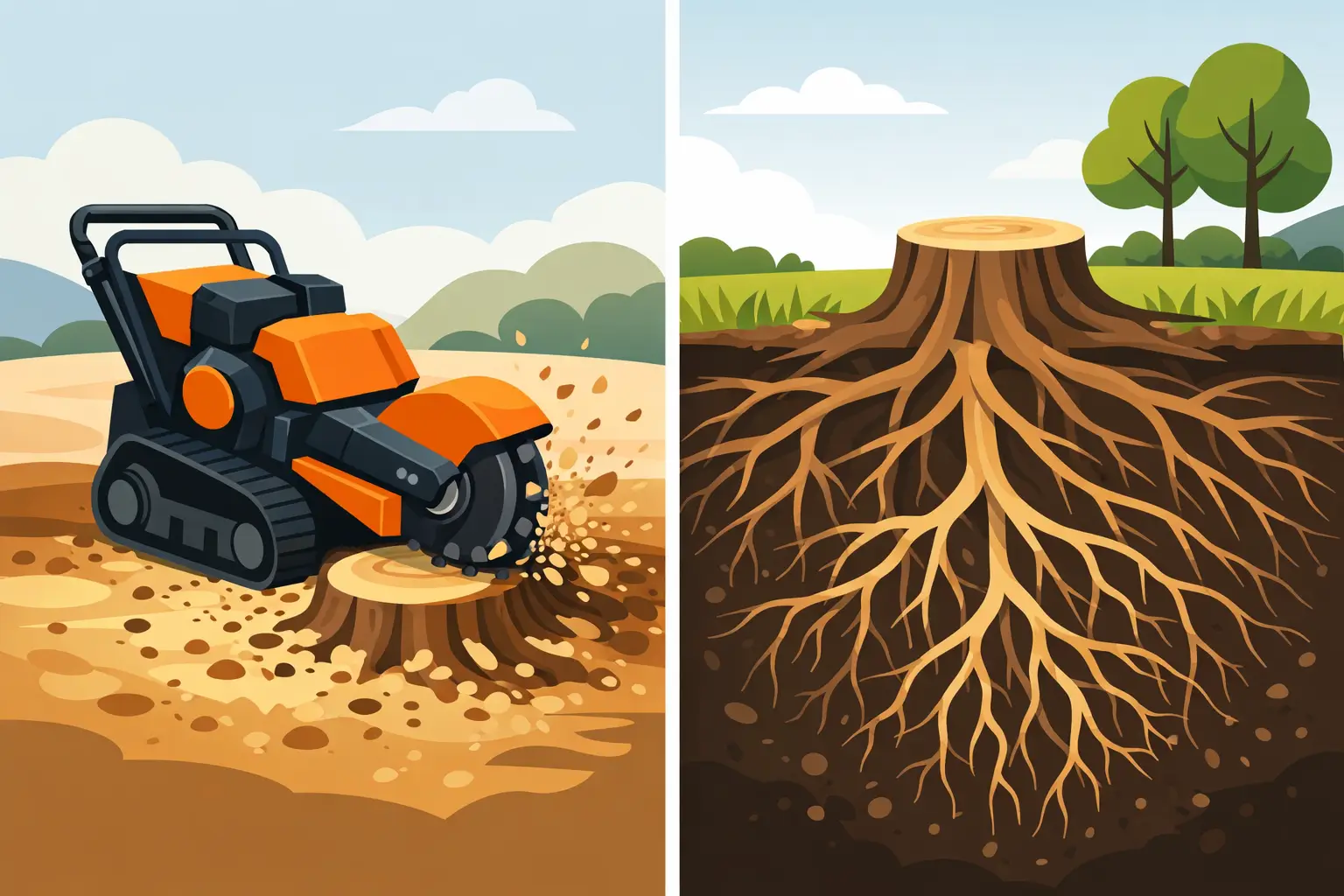
If you have got an old stump sitting in the lawn or garden bed, one of the first questions that comes up is simple – does stump grinding remove roots? The short answer is no, not completely. Stump grinding removes the visible stump and grinds down the upper root plate, but it usually does not remove the entire root system running through the soil.
That matters because what happens below ground affects what you can do with the space next. If you are planning to turf the area, replant, pave, or tidy up a commercial frontage, it helps to know exactly what stump grinding does and does not solve.
What stump grinding actually removes
Stump grinding is designed to deal with the stump itself. A specialist machine grinds the timber down below ground level, usually turning the main stump into wood chips and breaking up the larger crown roots near the base.
In most cases, the grind goes deep enough to remove the obvious remains of the tree and leave the surface suitable for backfilling and finishing. From above ground, the stump is effectively gone. That is why stump grinding is such a popular option for homeowners and property managers who want a cleaner, safer, better-looking outdoor area without the cost and disruption of digging out the whole system.
What stays behind are the longer structural roots spreading away from the stump. These roots can run well beyond the original trunk, depending on the tree species, the age of the tree, and soil conditions. Grinding does not chase those roots out across the section.
Does stump grinding remove roots enough for most jobs?
Usually, yes. For many properties, stump grinding removes enough of the roots to make the area usable again.
If your goal is to get rid of a trip hazard, stop mowing around an ugly stump, improve the look of the garden, or prepare the spot for topsoil and grass, stump grinding is often the right solution. It is faster and less invasive than full stump and root excavation, and it avoids tearing up a large patch of lawn or garden just to remove roots that may not cause any practical issue.
This is why, for most residential work, complete root removal is not necessary. Once the stump and main base roots are ground out, the remaining roots underground will generally start to break down over time.
There are, however, situations where partial root removal is not enough.
When leftover roots can still be a problem
Not every site is the same. In some cases, the remaining roots are harmless. In others, they can interfere with what you want to do next.
If you are planning to build over the area, install a new hardscape, excavate for services, or create a perfectly level finished surface, leftover roots may become an issue. As they decompose, they can leave voids in the soil. That can lead to minor sinking or soft spots, especially if the ground has not been properly filled and compacted.
The same applies if there are large roots close to the surface. Even after the stump is gone, those roots might still affect replanting, edging, paving, or excavation work nearby. In tighter spaces, older root systems can also be wrapped around pipes, retaining edges, or existing garden features.
Some tree species also behave differently after removal. While many roots simply die off, others can continue to sprout from the remaining root system if the species is prone to suckering. In that case, grinding the stump solves the main visual problem, but follow-up treatment may still be needed.
The difference between stump grinding and full removal
This is where people often get caught out. Stump grinding and stump removal sound similar, but they are not the same job.
Grinding removes the stump below ground level and some of the major roots around the base. It is efficient, tidy, and well suited to most landscape and garden improvement work.
Full removal means excavating the stump and lifting out much more of the root mass. That usually involves heavier machinery, more labour, more soil disturbance, and a larger repair area afterwards. It can be the better option if you need a completely clear site, but it is not always the most practical one.
For many customers, the better question is not just does stump grinding remove roots, but whether it removes enough roots for the intended use of the area. That is the decision point.
What happens to the roots left in the ground?
Once the tree is cut down and the stump is ground, the remaining roots usually stop growing and begin to decay naturally. How long that takes depends on the size of the roots, the species of tree, and moisture in the soil.
Smaller roots can break down fairly steadily. Larger roots can take years. During that time, they are mostly an underground issue rather than a surface one, but if you are doing major landscaping or construction in that exact area, it is worth planning for it.
In some gardens, the decomposition is hardly noticed. In others, the ground may settle a little as organic material breaks down. That is why proper clean-up, backfilling, and surface preparation after grinding matter just as much as the grinding itself.
Can you plant over a ground stump?
Often, yes, but with some care.
If you are re-grassing the area or adding soil and planting shallow-rooted garden material nearby, stump grinding usually leaves the site in good shape for that next step. The main thing is removing excess grindings if needed, topping up with quality soil, and making sure the area is level and compact enough.
If you want to plant another tree in exactly the same spot, it can be more complicated. Leftover roots, old wood matter, and limited fresh soil can all affect how well a new tree establishes. In that case, moving the planting position slightly or doing more site preparation may be the smarter option.
For paving, edging, bin areas, or other practical outdoor improvements, the ground may need extra excavation and compacted base material anyway. That is where a broader siteworks approach can make more sense than treating stump grinding as a stand-alone task.
How to know if root removal is worth the extra cost
The answer comes down to the planned use of the site.
If the stump is in the middle of a lawn and you simply want a neat, safe finish, full root removal is often unnecessary. Grinding gets the result most people want with less mess and less cost.
If the area is being redeveloped, built on, resurfaced, or heavily replanted, then a more aggressive removal method may save headaches later. Paying more upfront can be worth it if it prevents settlement, drainage issues, or rework.
A good operator should be upfront about that. Not every stump needs full excavation, and not every property should be sold the biggest job possible. The practical choice depends on access, tree size, root spread, nearby structures, and what you need the space to do afterwards.
Why professional assessment matters
Stump work looks simple from a distance, but the ground around a stump can hide all sorts of variables – shallow roots, buried services, retaining edges, irrigation lines, old concrete, or tight access for machinery.
That is why site-specific advice matters. A professional can tell you whether standard grinding will be enough or whether the root system is likely to affect the next stage of your project. For property owners, that means fewer surprises and a cleaner finish.
For businesses like Kandu Gardens that handle broader outdoor improvements, this kind of advice is especially useful because stump grinding is often only one part of the job. The real goal is not just to get rid of timber in the ground. It is to leave the area ready for whatever comes next, whether that is lawn repair, planting, hardscaping, excavation, or a full garden refresh.
So, does stump grinding remove roots?
Yes, but only the roots closest to the stump. It does not remove the full root network underground.
For most homes and many commercial sites, that is completely fine. The stump is gone, the area looks better, and the space becomes easier to use. Where people run into trouble is assuming that grinding means total root extraction. It does not.
If you are not sure what level of removal your site needs, the best approach is to match the method to the outcome you want. A tidy lawn fix, a fresh garden bed, and a construction-ready site all have different requirements. Getting that right at the start usually saves time, money, and rework later.
A stump can be out of sight in a day, but the best result comes from thinking one step past the removal and planning the ground for what you want to enjoy next.